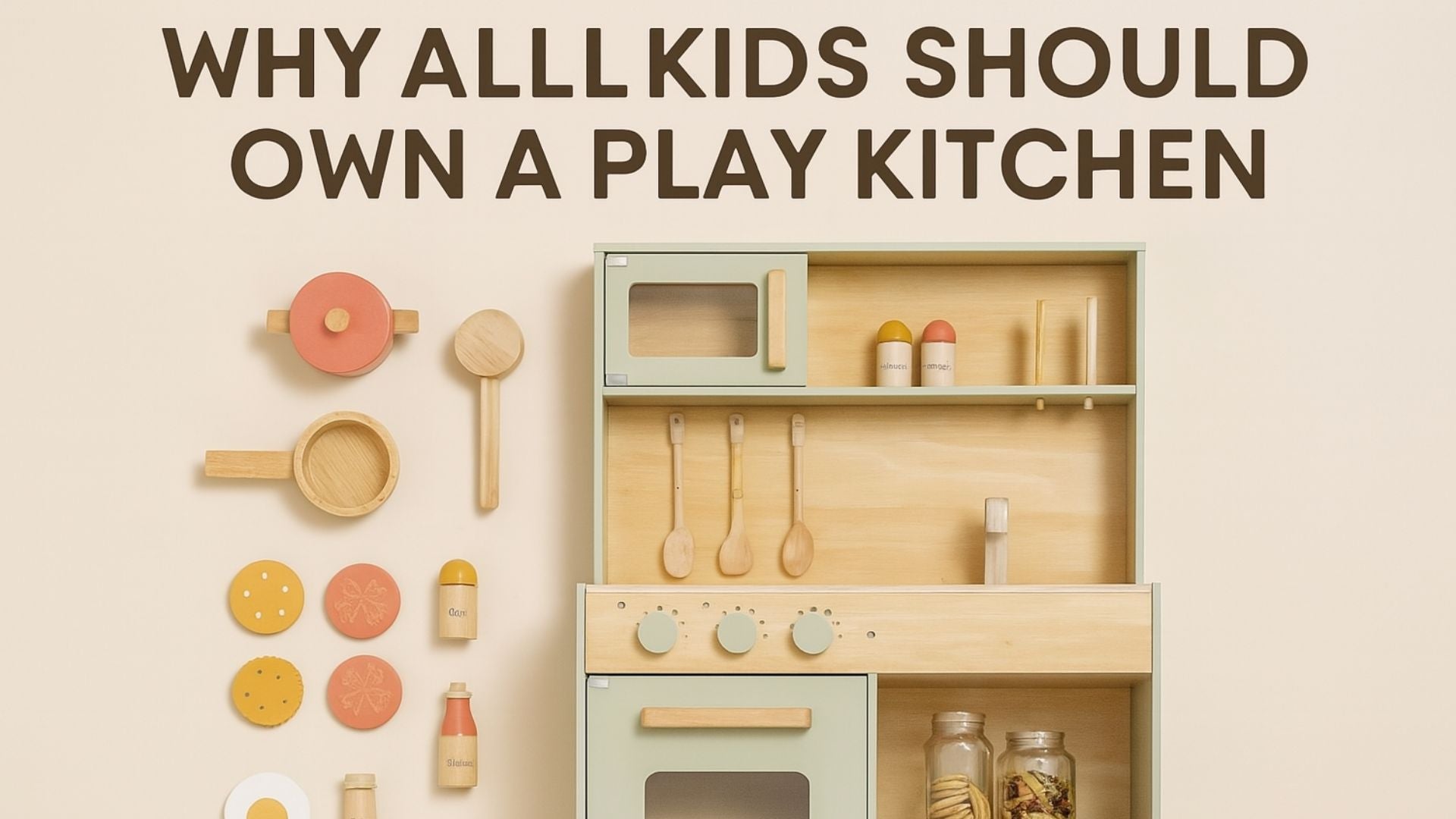
Every wooden play kitchen sold in the UK carries the same label: age 3+.
And every year, thousands of parents ignore it, buying one for an 18-month-old's birthday, wrapping one up at Christmas for a two-year-old who won't stop "cooking" with the TV remote and a shoe.
They're right to. That 3+ marking is an EN71 toy safety classification, driven by small parts in the accessories (tiny wooden eggs, acorn-sized fruit, miniature cutlery), not a developmental recommendation.
The kitchen itself is perfectly fine from around 18 months. The choking-hazard accessories are the issue, and those can wait in a cupboard until your child's past the everything-in-mouth stage.

So when should you actually buy one? And just as importantly, how much play will you get out of it, what are the benefits, and when do they stop using it?
Quick Takeaways
- Play kitchens suit children from roughly 18 months to age 7, with peak use between 3 and 5
- The "3+" label is a small-parts safety rating, not a developmental verdict
- Under-3s explore and imitate; over-3s build storylines and play cooperatively
- Accessories matter as much as the kitchen. Rotate them to extend the lifespan
- Wooden kitchens outlast plastic by years and suit UK living spaces better
The short answer: 18 months to 7 years, with 3–5 as the sweet spot
Most play kitchens carry a "3+" label, but that's a small-parts safety rating, not a developmental one — the kitchen itself is fine from around 18 months once you hold back any choking-hazard accessories.
Good to know: A “3+” label is usually a small-parts safety rating, not a developmental recommendation. Many play kitchens are suitable from around 18 months with age-appropriate accessories.
At 18 months to 2, children explore: opening doors, turning knobs, copying what they've seen you do.
From 2 to 3, pretend play kicks in, and a block becomes a sandwich. Between 3 and 5 is peak use — cooperative role-play, café games, language-rich storytelling, and the age when a play kitchen ticks the most EYFS boxes at once.
From 5 to 7, the play shifts from imitation to narrative: handwritten menus, price lists, and restaurant service.
By around 7, most children naturally move on. Boys and girls use them at the same rate, wood outlasts plastic by years, and the accessories you stock it with matter as much as the kitchen itself.
| Age | Stage | What to Expect | Key Benefits |
|---|---|---|---|
| 18 months – 2 years | Explorer Stage | Opening doors, turning knobs, stirring spoons, and copying what they see adults do. Mostly sensory and imitation play. | Fine motor skills, sensory play, imitation |
| 2 – 3 years | Pretend Play Begins | Invented meals, teddy picnics, imaginary tea parties, and early pretend play. | Imagination, symbolic thinking, independent play |
| 3 – 5 years | Peak Play Years | Running cafés, taking orders, storytelling, and cooperative role play with siblings or friends. | Language, creativity, social skills, fine motor development |
| 5 – 7 years | Narrative & Literacy Play | Creating menus, café games, price lists, and larger storytelling scenarios. | Literacy, creativity, structured play |
| 7+ years | Natural Wind-Down | Pretend play gradually fades as children move toward real cooking and more structured activities. | Real-world skills, independence |
What can an 18-month-old actually do with a play kitchen?
At this age, it's all exploration (opening doors, turning knobs, stirring a spoon around a pot) and that's exactly what their development calls for.

Around 18 months, toddlers begin what developmental psychologists call deferred imitation: copying actions they saw you do earlier, which is why it’s so important to proactively have your kids around and, up to their capacity, helping you when you’re working in the kitchen.
The NHS developmental guidance for this age highlights self-feeding with a spoon, stacking objects, and turning chunky dials, all of which a play kitchen provides.
Don't expect sustained pretend play yet.
You'll get short bursts: a wooden spoon stirred furiously for 30 seconds, then abandoned. The oven door opened and closed 40 times in a row. A plastic croissant carried to your mouth with great seriousness, then dropped on the floor.
This is Piaget's sensorimotor-to-preoperational transition playing out in real time, and it's exactly right.
At this stage, look for sturdy construction, large, rounded knobs, and a hinged door that can take repeated slamming.
The Kidoz Signature range works well here. It's compact at 54 cm wide, with clicking dials and chunky features sized for small hands. Skip anything with batteries.
At 18 months, a child gains more from making their own sizzle sounds than from a pre-recorded one. They’re learning about the world and why it works. Why does something sizzle? Because it’s hot, and moisture is cooking off.
This is how they learn.
When does pretend play really kick in?
Between ages 2 and 3, children start using one object to represent another (a block becomes a sandwich, a wooden cylinder becomes a sausage), and that's when a play kitchen goes from furniture to favourite toy.

This is what Piaget called the “preoperational stage”, and it's a significant cognitive leap. Your child isn't just copying what you did in the kitchen anymore. They're inventing meals, assigning meaning to objects, and narrating as they go.
Play at this age is still mostly solo or parallel, alongside other children, not yet cooperating with them.
Mildred Parten described this pattern in her famous 1932 research on social play, and it still holds. Your two-year-old will "cook" elaborate combinations no adult would attempt, set out picnics for teddies, and pour invisible tea with absolute conviction.
Fine motor skills sharpen quickly between 2 and 3: pouring from jug to cup, transferring food between bowls, and unscrewing simple lids.
This is the age where a wooden kitchen genuinely earns its price, and the most popular UK gifting moment (second birthdays and the Christmas around them) lands here for good reason.
Accessories become critical now.
The stainless steel pots and utensils included with the pink and grey Kidoz kitchens give children something to fill, stir, and serve with immediately.
Adding wooden play food expands what they can cook, and rotating the food every few weeks keeps the kitchen feeling fresh.
What age is best for a play kitchen?
The sweet spot is 3 to 5. Children at this age move into cooperative, language-rich role play (running cafés, taking orders, telling off the teddy for not eating his greens), and a play kitchen supports multiple EYFS learning goals at once.

If there's a "perfect age" for a play kitchen, this is it, and the developmental research explains why.
Israeli educational psychologist Sara Smilansky identified six features of sociodramatic play in her 1968 research: imitative role-taking, make-believe with objects, make-believe with actions, persistence of at least ten minutes, interaction with at least one other player, and verbal exchange.
A play kitchen is almost purpose-built to deliver all six. Watch a group of four-year-olds with a well-stocked kitchen, and you'll see every one of Smilansky's features within the first five minutes.
This is also where the UK's Early Years Foundation Stage framework does its heaviest lifting.
A play kitchen supports:
- Expressive Arts and Design (role-playing characters and narratives)
- Communication and Language (extending vocabulary through café and dinner-party scripts)
- PSED (working cooperatively, taking turns)
- Physical Development (using small tools, including cutlery).
Few toys tick that many boxes simultaneously.
Vygotsky put it memorably: in play, a child "behaves beyond his average age, above his daily behaviour; in play it is as though he were a head taller than himself."
You'll see it when your four-year-old gravely charges you £100 for soup and informs you there's no pudding because the chef is on holiday.
At this stage, look for a kitchen with enough space and features to sustain longer play sessions.
The Kidoz Deluxe play kitchen is 91.5 cm wide with a fridge, ice maker sounds, and room for two or three children to play side by side. Velcro cutting food adds a fine motor dimension.
Snipping a wooden apple in half with a play knife is surprisingly satisfying at four, and it practises the bilateral coordination (one hand holds, one hand cuts) that'll matter when real scissors arrive at school.
Is 5 too old for a play kitchen?
Not even close. Between 5 and 7, the play evolves from imitation into narrative: handwritten menus, price tags, multi-step recipes, and café-style service.

The kitchen doesn't disappear at this age. It transforms.
Fine motor skills are far more refined by Reception and Key Stage 1.
Children can button a chef's apron, cut precise shapes from play-dough, whisk with purpose, and follow pictorial recipe cards. Hand dominance is established, pencil grasp is mature, and literacy starts bleeding into the play.
You'll find menus scrawled on scraps of paper, "OPEN" and "CLOSED" signs taped to the fridge, and price lists for dishes that don't exist.
If the kitchen has a chalkboard panel (the Kidoz Deluxe fridge does), it becomes a menu board.
If it doesn't, a sheet of paper and some Blu-Tack will do the same job. The point is that the kitchen is now a prop inside a larger story, and that story can run for an entire afternoon.
On Mumsnet, parents of 5- to 7-year-olds consistently report this pattern.
One writes: "My nearly 6-year-old does still play with hers, but it's morphed mostly into a café. We have the kitchen pulled out so she can use the gap as a serving hatch and stick menus and posters on the back."
Others report daily use through to age 7, especially when siblings or friends are involved.
Is 7 too old for a play kitchen?
Seven is roughly where domestic pretend play winds down naturally. Smilansky observed this in 1968, and Piaget's concrete operational stage (around age 7) explains why. Children shift from imaginative scenarios toward games with rules, structured activities, and real-world skill building.

Board games, sports, Lego with instructions, and cooking with actual ingredients all become more appealing than cooking with wooden ones.
That said, pretend play doesn't switch off overnight.
A 2012 retrospective study by Smith and Lillard found the average reported age at which children stopped pretending altogether was around 11.
Kitchens often survive past the expected expiry date because younger siblings inherit them, visiting friends rediscover them, or they become the permanent base for restaurant and shop games.
When your child genuinely stops using it, you'll know. The kitchen will sit untouched for weeks. That's the signal, not a number on a box.
Do boys play with toy kitchens?
Yes, and the evidence from EYFS settings is clear: boys and girls engage with home-corner play at the same rate.
The "home corner" in every Reception classroom is gender-neutral by design, and the developmental gains in language, cooperation, and fine motor control don't differ by gender.
On parenting forums, parents of boys are emphatic. Cooking is a universal life skill, and the kitchen is for everyone.
What should you look for at each age?
Under 2, prioritise solidity over features. Ages 2 to 4, accessorise heavily. Ages 4 to 7, look for features that support storytelling: chalkboards, sinks, drawers, and menu space.

For the youngest children, the kitchen needs to survive being climbed on, leaned against, and having its doors tested to destruction. Large knobs, no small loose parts, and a wooden body that won't tip.
The kidoz signature at 54 cm wide fits against a wall in a small flat and won't dominate the room.
For 2- to 4-year-olds, the accessories matter as much as the kitchen. Stock it with pots, pans, a tea set, and wooden play food, then rotate items every few weeks to keep the play fresh. Choose a kitchen tall enough to grow into.
If space is tight, the Hooga mint kitchen fits into just 39 cm of width.
For 4- to 7-year-olds, features that extend narrative are worth the investment. A chalkboard fridge, a sink for "washing up," drawers for sorting cutlery, and enough counter space for two children to work side by side.
The kidoz deluxe covers all of these, and at 91.5 cm wide, it's built for the kind of sustained café play that five- and six-year-olds love.

A note on materials.
Wooden play kitchens outlast plastic ones by years, and UK parents on Mumsnet are nearly unanimous on this point. Plastic character-branded kitchens draw repeated complaints for cracking, fading, and falling apart within 12 months.
A good wooden kitchen serves two children from 18 months to seven, looks fine in a living room, and resells well when it's outgrown. The cost-per-year, viewed that way, is modest.
The right kitchen at the right moment
The "3+" on the box is a safety label, not an answer. The answer runs from 18 months to around seven, with the richest play landing between three and five. Buy too early, and you'll wait a few months for the play to catch up to the kitchen.
Buy too late, and you'll miss the developmental window where a play kitchen does its best work — the years when a wooden oven, a few pots, and a teddy bear who needs feeding can teach a child more about language, cooperation, and imagination than most toys costing twice the price.
Browse the Small Smart play kitchen collection to find the right fit for your child's age and your home's space.